

Why Is My Furnace Making That Noise? A Sound-by-Sound Guide for Heating Season
The good news: When you went to turn on your furnace for the first time this year, it worked! Heat!
The less good news: Shortly after, it started making a funny noise.
Did it make that sound last year? Was it that loud?
As Minnesotans, we get it. It’s hard to settle in under a blanket when you’re wondering whether the thing keeping your house warm is maybe trying to tell you something.
Plenty of furnace sounds are completely normal. Some are worth keeping an ear on. A few mean it’s time to shut things down and call us—before you’re left in the cold. Let’s sort out which is which.
What’s Normal When Your Furnace First Fires Up for the Season
A working furnace isn’t silent, and it isn’t supposed to be. When everything is running the way it should, you might hear:
- A soft whoosh when the burners light
- Light ticking or popping as the metal ductwork warms up (and again as it cools down)
- The blower starting up and winding down at the beginning and end of each cycle
- A few clicks at startup from the igniter or a relay
You may also notice a faint burning smell the first few times the furnace runs each fall. That’s usually dust that settled on the furnace over the summer burning off. If the smell hangs around past those first few runs, that’s a reason to call.
Even normal furnace noises take some getting used to each year. It’s like how 40 degrees feels downright balmy when it first hits in spring, but frigid when it initially returns in the fall.
A Sound-by-Sound Furnace Noise Guide
Still not sure? Here are common furnace sounds, what usually causes each one, and what we’d do about it. A lot of these sounds are “in the ear of the beholder,” so when in doubt, don’t be afraid to call us.
The sound: Clicking
A few clicks when the furnace starts is normal. Repeated clicking without the burners lighting can point to an issue with the igniter or flame sensor.
What to do: Schedule a visit with Bonfe, especially if the house isn’t warming up.
The sound: Banging or booming at startup.
A bang right as the furnace kicks on is often delayed ignition, which is when gas builds up for a moment before it lights. Dirty burners are a common cause. Softer popping from the ducts is something else, and it’s usually just metal expanding and contracting as it heats and cools.
What to do: For soft popping from the ductwork, keep an ear on it. For a boom from the furnace itself, schedule a visit with Bonfe. If the booming keeps happening, turn the furnace off and call.
The sound: Squealing or screeching.
This is often the blower motor, which may need lubrication. On older furnaces with a belt-driven blower, it can also be a belt that needs adjusting or replacing.
What to do: Schedule a visit with Bonfe. Better safe than cold.
The sound: Rattling.
Usually something loose: a panel or screw, a part inside the blower, or a section of ductwork.
What to do: Make sure the furnace door panel is seated properly (more on that below). If the rattle seems to be coming from inside the furnace, schedule a visit with Bonfe.
The sound: Humming or buzzing.
A loud hum or an electrical buzz can point to a motor, a capacitor, or another electrical component.
What to do: Schedule a visit with Bonfe. Electrical parts are a job for a technician. This is not something you want to mess around with.
The sound: Whistling.
Usually a sign of restricted airflow, often from a dirty filter or blocked vents. This is one you can usually check yourself.
What to do: Start with the quick checks below. If it’s still whistling with a clean filter and open vents, schedule a visit with Bonfe.
The sound: Scraping or grinding. Metal on metal, often from the blower wheel or the motor bearings.
What to do: Turn the furnace off and call Bonfe.
Quick Checks You Can Do Yourself
In situations where it’s safe to do so, a few easy checks can rule out the simple stuff:
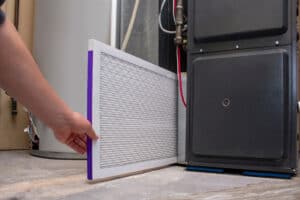
Replace the filter.
A clogged filter cuts airflow and makes the furnace work harder and longer. The Minnesota Department of Commerce recommends replacing a standard 1-inch filter monthly. Thicker pleated filters may last several months, so check your furnace manufacturer’s guidance.
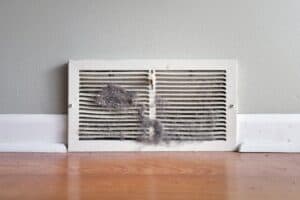
Make sure vents and registers are open and clear.
Furniture and heavy curtains can block the airflow to a room
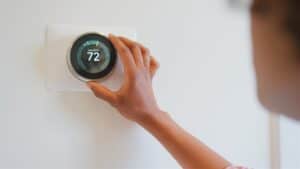
Check the thermostat.
Confirm it’s set to heat and that the set temperature is higher than the current room temperature.
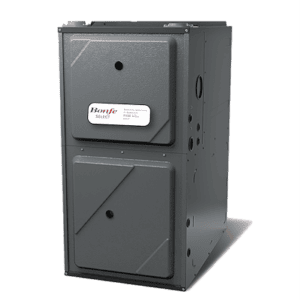
Confirm the furnace door panel is seated.
A loose panel is one of the rattle causes above.
If you’d rather not poke around the furnace yourself, no judgment. That’s what we’re here for (7 days a week).
When to Stop and Call a Pro
Some situations aren’t wait-and-see. Turn the furnace off and call us if you notice:
- Grinding or scraping
- Booming at startup that keeps happening
- A burning or electrical smell that doesn’t go away
- The furnace turning on and off frequently
- No heat
An important note: One situation calls for getting out of the house before you call anyone. If you smell gas (often described as a rotten-egg smell), Minnesota’s Office of Pipeline Safety says to get everyone out right away, avoid turning lights or appliances on or off, and call 911 once you’re a safe distance away.
And because carbon monoxide has no smell, the Minnesota Department of Commerce recommends code-required CO detectors near every fuel-burning appliance and within 10 feet of every bedroom.
How Regular Maintenance Keeps Things Quiet
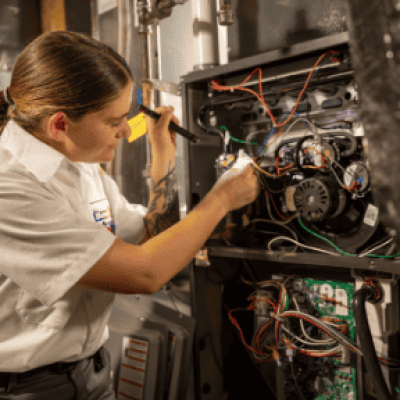
Several sounds on this list show up as parts that wear down or get dirty over time. A tune-up can catch them before they get loud (and more expensive to fix).
During an annual furnace tune-up, a qualified technician can check the igniter and flame sensor, inspect the heat exchanger and blower motor. Those are the same parts behind the clicking, booming, and squealing we covered above.
Why Bonfe?
Our technicians can pinpoint the cause of a sound you can’t place, give you upfront pricing before any work starts, and back the repair with our Lifetime Parts & Labor Warranty.
- Voted Minnesota’s Best Heating and Cooling Company
- Lifetime Parts & Labor Warranty
- Skilled, licensed technicians
- Quality workmanship
- Upfront pricing, with no surprises once the job starts
- 4.8 stars from over 11,800 Google reviews
- 100% family-owned since 1993
- Regular rates from 7am to 10pm, 7 days a week
- 24/7/365 emergency service for after-hours issues
Hear Something New? Let’s Figure It Out.
When you call, tell us what you’re hearing and when it happens: at startup, the whole time the furnace runs, or as it shuts off. That helps our technician know where to start.
Not sure what you’re hearing or what’s going on? Don’t worry—that’s why we’re here. We’ve, quite literally, heard it all.